
Where should a beginner start learning Bulgarian?
Start with the writing system and a small set of useful sounds and words. Bulgarian uses Cyrillic, so learning the letters early helps you read menus, place names, signs, and simple lesson prompts without relying on Latin spelling.
From there, connect each new word to its pronunciation and use it in a short recall task. A useful first sequence is Cyrillic recognition, everyday vocabulary, listening, speaking practice, and regular review. You do not need to master every grammar topic before you begin reading and remembering real Bulgarian.
If you are starting with the script, use our Bulgarian alphabet guide and then continue with the beginner pronunciation guide .
01 / Foundations
Start with Bulgarian Cyrillic
Bulgarian has 30 modern Cyrillic letters. Some are familiar shapes, while others look like Latin letters but represent different sounds. Learning the sound with the letter prevents a common beginner trap: reading a Cyrillic word as if it were written in English.
Merakuest begins its path with Cyrillic recognition and example words such as вода (water), дом (home), хляб (bread), and котка (cat). The goal is to make the alphabet something you can use, not a chart you only memorize once.
02 / Vocabulary
Build useful Bulgarian vocabulary
Choose words that can anchor short phrases and scenes. The current Merakuest Cyrillic path includes practical items such as вода, хляб, книга, дом, роза, котка, куче, ябълка, шапка, and сол. These words give you repeated contact with common letter patterns while keeping the meaning concrete.
Learn a word in three layers: see it in Cyrillic, hear it, and recall it from a clue or image. Keep the Bulgarian spelling visible while you are learning it, then gradually rely less on transliteration.
03 / Listening
Hear and pronounce Bulgarian
Pronunciation belongs beside reading rather than after it. Listen to an example word, repeat it at a comfortable pace, and notice where the stressed syllable stands out. Merakuest uses Bulgarian examples such as здравей (hello), чай (tea), and Добро утро (good morning) in its learner content.
For a focused explanation of vowels, consonants, stress, and the sounds that often need extra practice, read the Bulgarian pronunciation guide .
04 / Recall
Practice through active recall
Recognition feels comfortable, but recall is what helps a word become available when you need it. Short tasks can ask you to choose a meaning, identify a first letter from audio, type a Cyrillic answer, solve a crossword, or connect an image to a word.
Varying the prompt also varies the memory path. That is why the app combines reading, listening, visual vocabulary, typed answers, and review rather than repeating one format for every lesson.
05 / The journey
Progress through the Merakuest journey
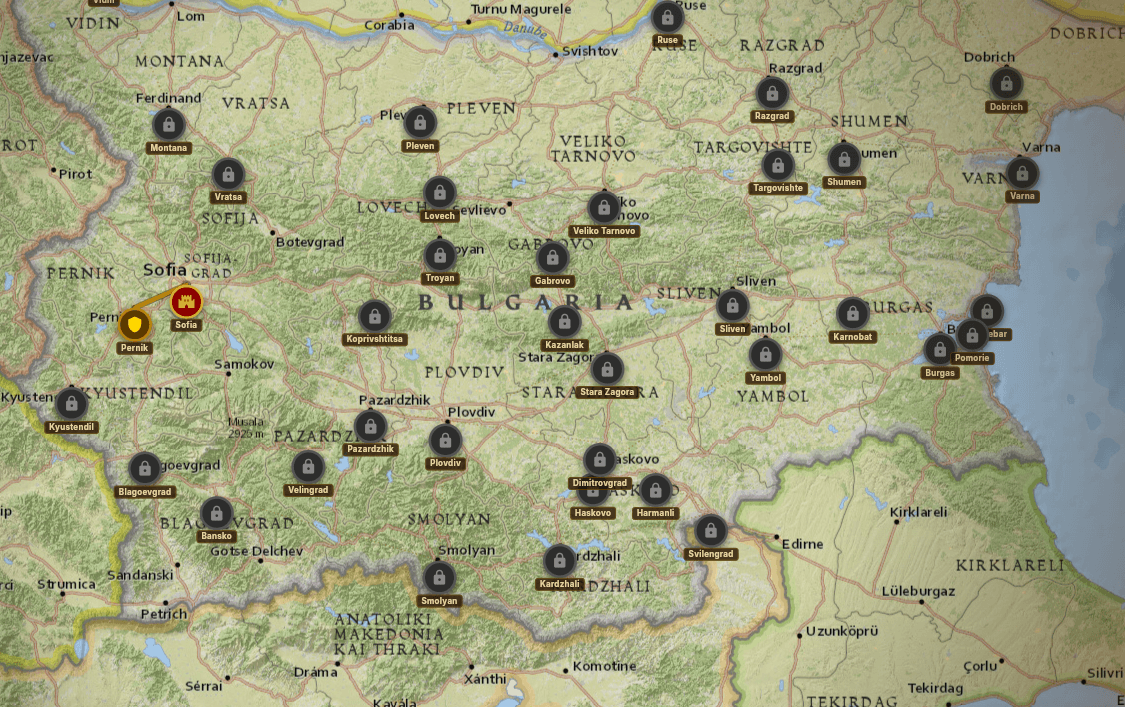
Merakuest turns Bulgarian practice into chapters shaped around places in Bulgaria. You move from Sofia through a map-based route, meet focused challenges, and finish chapter work with review encounters that test what you have learned.
The product is currently in beta. Access is limited while early learners help the team improve the lessons, exercises, and overall adventure. Requesting access is not a promise of an invitation.
A practical path for Bulgarian beginners
- Learn the 30 Cyrillic letters. Pair each shape with a sound and a simple example word.
- Read short words. Use familiar patterns before moving into longer phrases.
- Add useful vocabulary. Study words you can picture, hear, and reuse.
- Listen and repeat. Notice stress and keep the rhythm comfortable.
- Recall without looking. Use short quizzes, typed answers, and spaced review.
- Return consistently. Small sessions make the next chapter easier to enter.
Explore more Bulgarian learning resources
Limited beta access
Ready to make Bulgarian part of your route?
Complete the beta application form. Invitations are limited while Merakuest is being improved with early learners.
Request beta access